Operational process orchestration—brick by brick
No process derails
without warning.
Bricksta ends the loss of control in operational, cross-team processes.
For processes that span several teams — and where customers, suppliers or auditors do part of the work.
- Faster processes
- Early warning and automatic escalation
- More margin through clear flows
- More volume without more headcount
- Solid numbers instead of status meetings
Personal onboarding · Free during the pilot phase · No credit card
This is what every running case looks like — here's one that's derailing.
Act now
2 items, most urgent firstWhat changes
Not “better overview” — four things that are measurably different afterwards.
You hear it first, not from the customer
Every running case carries a forecast against its due date. If it runs past it, Bricksta escalates on its own — with the bottleneck and a concrete next step. The question “Why did nobody see this?” disappears.
Handoffs stop costing days
Parallel steps actually run in parallel, follow-up tasks start by themselves once their prerequisites are met. Nobody waits for an “I'll let you know” any more.
One person carries more cases
Once the flow is set and ownership is clear per task, the same team handles more cases at once — without quality depending on who happens to be on shift.
Numbers a decision can rest on
Lead time, dwell time per phase and the bottleneck come out of the work itself, not out of reports. That turns margin and growth into a conversation about figures, not impressions.
Control is lost in the handoff, not in the work
Processes that cross several teams don't lose control because people work badly — but because between two steps nobody owns the whole. Work falls apart across email, spreadsheets, chat and meetings, ownership blurs, handoffs slip through the cracks. The warning signs are usually there weeks earlier. Nobody just sees them in one place.

Where Bricksta belongs
Wherever a flow crosses several teams, carries a deadline, and someone outside the company takes part.
Supplier and procurement
- Supplier onboarding
- Incoming goods inspection
- Procurement with approvals
Production and engineering
- Production ramp-up
- Maintenance
- Change requests
No off-the-shelf industry solution: the template comes out of your flow — described in words, from a document, or from a BPMN diagram.
One case, four views
The same truth at four distances — from the portfolio down to a single form field. Real screens, example data.
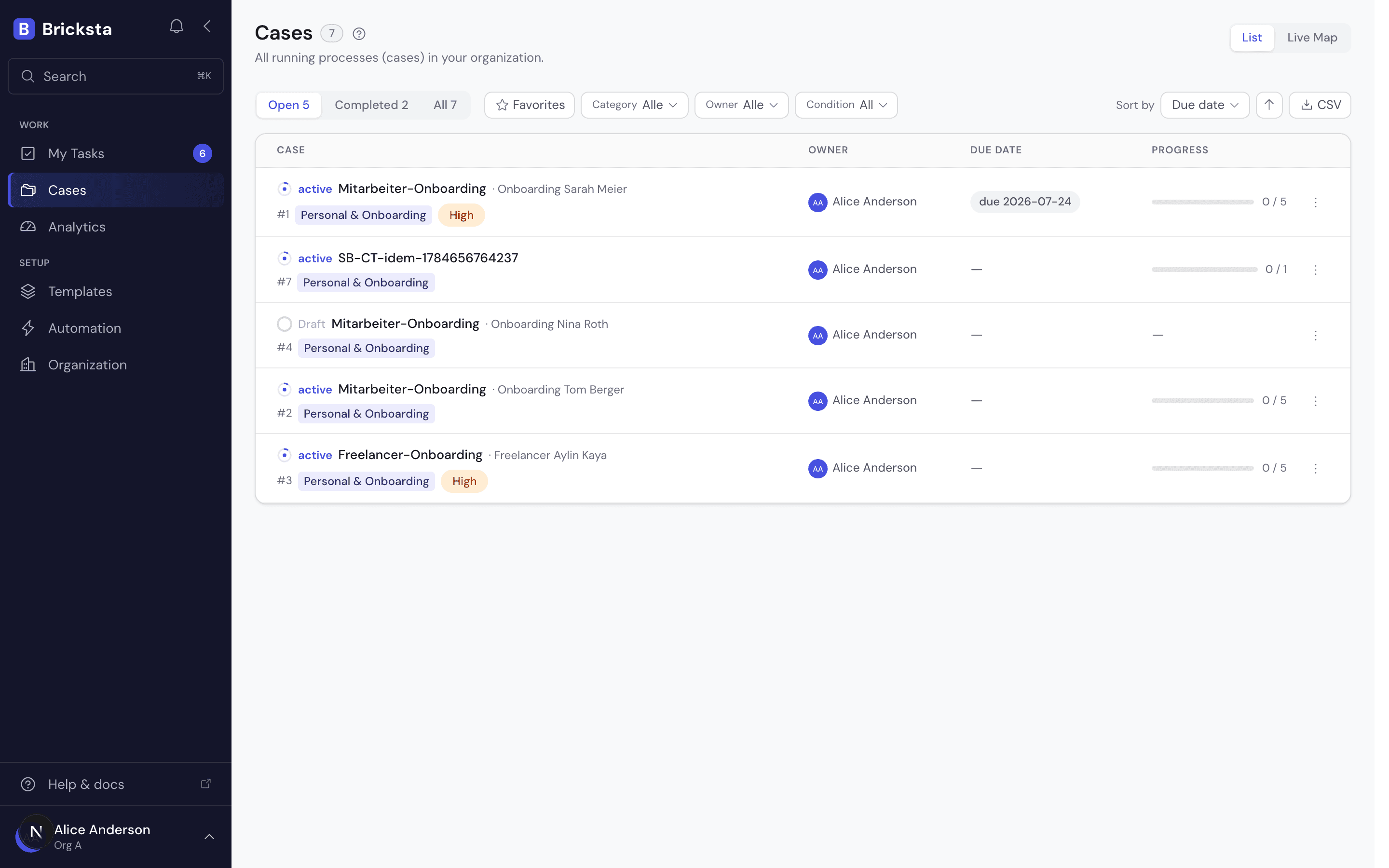
Every case side by side
Each running case with status, ownership, due date and progress. One line tells you what runs cleanly and what's stuck — across case types too.
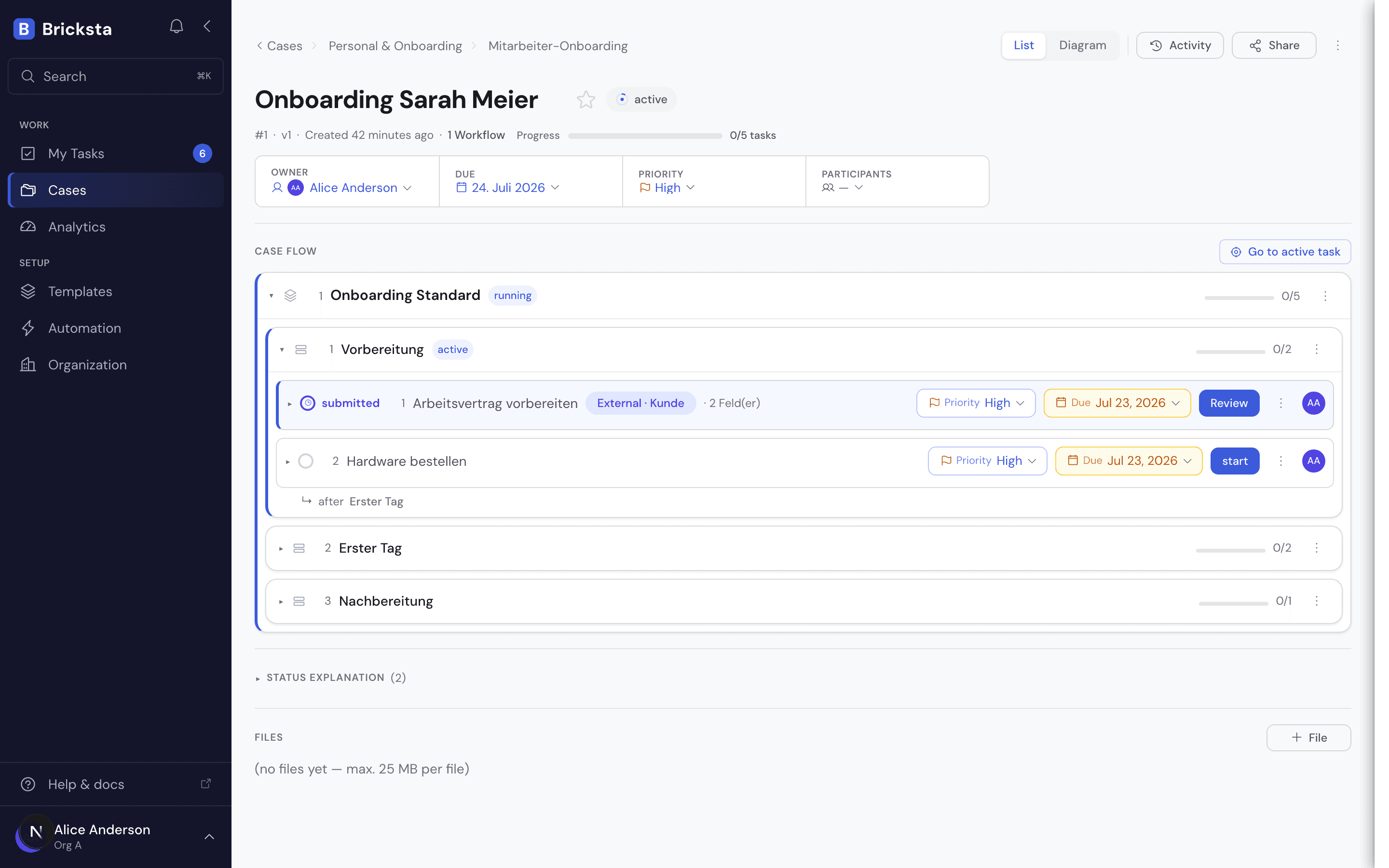
The single case, live
Phases, tasks and the task currently active. Status is derived from the work itself, not from a status report.
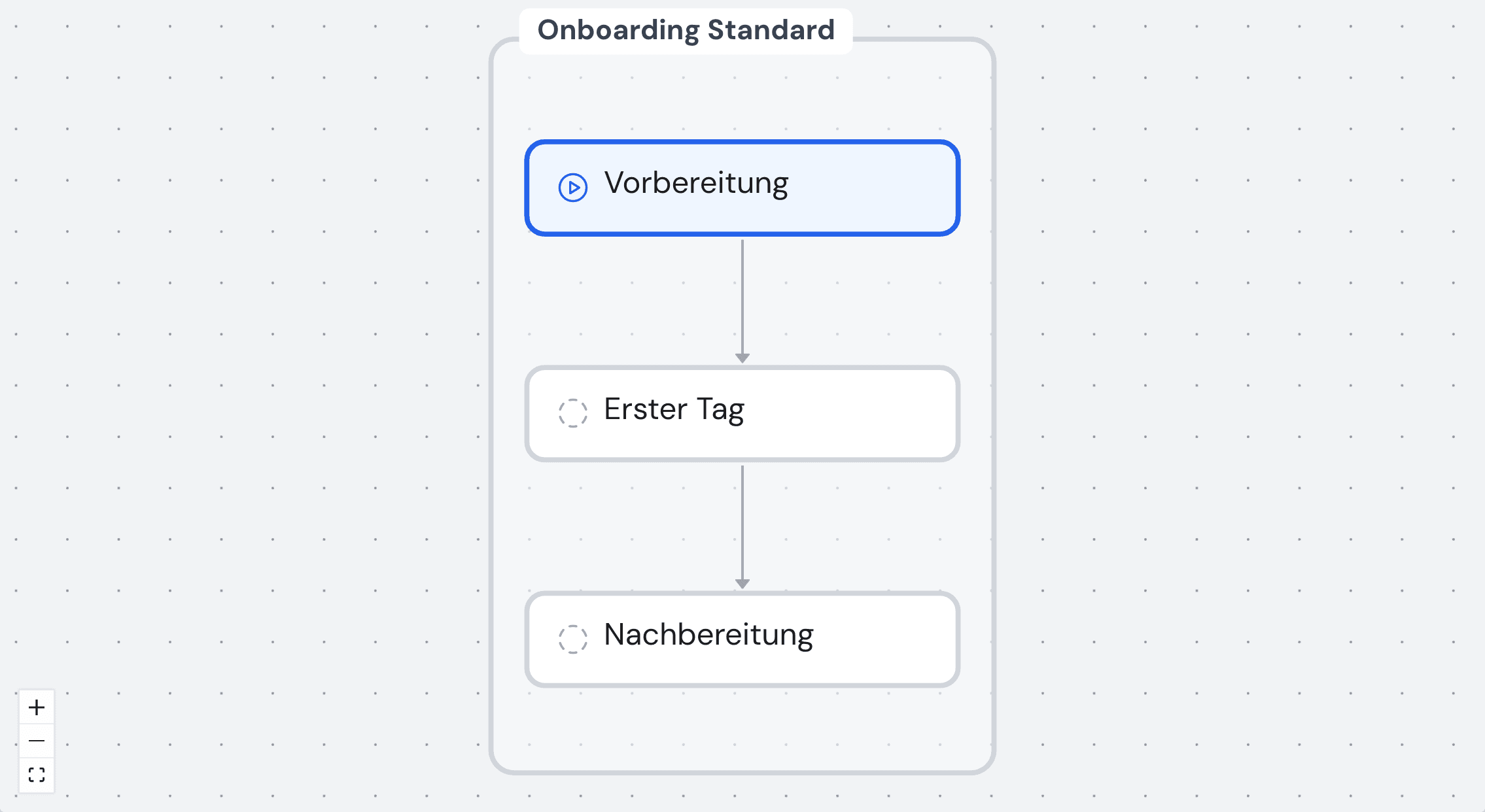
The flow as a diagram
Phases, order and dependencies as a picture — the process as it actually runs, not as it was intended.
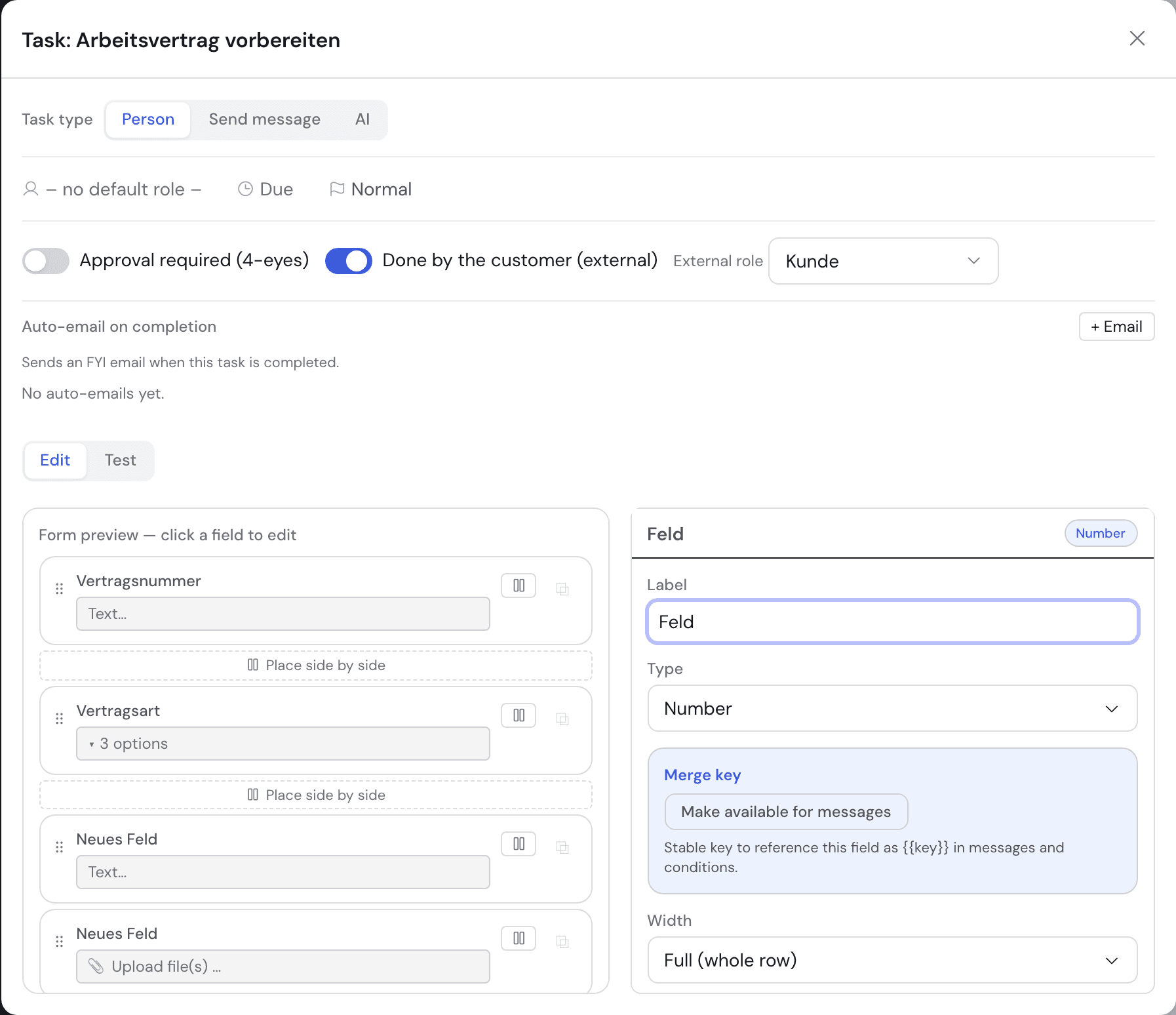
What each station captures
Define per task which fields get filled — field types, required fields, conditions and translations, without queueing up IT.
Describe the process. Bricksta builds it. The engine runs it.
Five stations, over and over. AI speeds up the describing — the engine owns execution, deterministic and traceable.
- 01
Describe
Hand in the flow in words, as a document or as BPMN. Out of it comes a template with phases, tasks, ownership and forms.
- 02
Run
People, automation and agents work in the same flow. The engine decides what comes next, and nobody has to pass the word along.
- 03
Measure
Lead time, dwell time per phase, deviations from the standard — out of the running work, not out of a report.
- 04
Steer
Early warning per case, automatic escalation when a norm is breached, and the bottleneck with a concrete next step.
- 05
Improve
When the standard deviates systematically — recurring ad-hoc tasks, skipped steps — Bricksta proposes the change to the template.
Why not the tools you already have
Bricksta doesn't solve the same problem a bit better; it solves a different one: steering running cases while they run.
Control, not documentation
A model shows the process as it should run. We show where each case stands today and where you need to step in — instead of maintaining models nobody reads.
Portfolio, not single boards
Task tools think in single boards. With thirty parallel cases you need the cross-cutting view, cross-process analytics and automatic escalation — not more boards.
A business team, not an IT project
No BPMN mandate, no weeks of modelling, no six-figure rollout. The first process runs in the same week.
Operated in Germany
German and European law, no CLOUD Act, no contract constructs to a US vendor. In regulated industries, often the first question asked.
Run it with your own numbers
The patchwork of chat, email, spreadsheets and status meetings looks free. It isn't — it just never shows up on an invoice.
Fully loaded cost, not salary. Bricksta does not take this to zero — but every hour that no longer goes into chasing information goes into work that reaches the customer.
What changes, and for whom
Three roles, three different questions — the same foundation.
Leadership and COO
“Does this scale without cost scaling with it?”
- Margin per process instead of gut feel
- A solid answer without asking the team
- Growth without proportional hiring
- Evidence when an auditor asks
Head of Operations
“Which case derails on me next?”
- Early warning per case, not only at escalation
- The bottleneck is stated, not guessed
- Less rework, fewer one-off exceptions
- The standard improves with every run
Team and customer
“What is my task right now?”
- One list instead of five inboxes
- Clear who is up next
- Customers, suppliers and auditors take part without a seat
- No asking which version of the form applies
Who may see what isn't a matter of trust
Gaining control must not hand out visibility nobody had before. So visibility belongs in the process, not in an agreement.
Roles and permissions
Who may see which template and who may act lives in roles and groups — not in people's heads. Tasks can only be assigned to people allowed to execute them.
Operated in Germany
Bricksta runs in Germany and is governed by German and European law. No US jurisdiction, no CLOUD Act.
Retention per field
How long something is kept and what happens to it then can be set down to the individual field — including marking it as personal data.
Unbroken history
Every step, assignment and status change is captured in a structured way. The history of a case stays visible and provable.
Pricing
Bricksta is in its pilot phase. Standard terms grow out of exactly these first partnerships — which is why there is no number there that we simply made up.
Pilot
- Personal onboarding
- One real process, set up together
- Full access to execution
- Cancel monthly
Standard
- Cases, workflows, task inbox, progress
- AI process generation as a monthly allowance
- Additional allowances as an add-on
- External participants without their own seat
Guided Setup
- We set up the first process with you
- Template, forms and roles built together
- Handover to your team
- Instead of a five-figure consulting project
Your first process runs within a week
“No rollout project” is a claim. Three timings are a commitment.
- 30 minutes
Pick the process
We look together at which of your flows loses the most control — and take that one, not the easiest one.
- One to two days
Build the template
Phases, tasks, ownership, forms. Described in words or taken from an existing document, then sharpened by hand.
- The same week
The first case runs
A real case, not a rehearsal. From then on Bricksta measures along — and you build the second template without us.
Six questions that always come up
- Does this replace our CRM?
- No. The CRM owns the customer relationship, Bricksta owns the flow. What already happens in a CRM, ticket system or inbox we don't model a second time — we orchestrate the work across them.
- How long does rollout take?
- The first process runs the same week: a half-hour conversation, one to two days for the template, then a real case. No modelling project, no IT queue.
- Our processes never run the same way.
- That's exactly why template and case are separate: the template says what is possible, the case is what happened. Ad-hoc tasks and skipped steps are allowed — they just become visible, and when they pile up, Bricksta proposes the change to the template.
- Who may see what?
- Visibility and the right to act run through roles and groups, per template and category. Tasks can only be assigned to people who are allowed to execute them.
- Do external people need an account?
- No. Customers, suppliers and auditors work on their task through an access link, without a seat and without an account. Their waiting time still counts towards the lead time of the case.
- What happens if we stop?
- Cancel monthly, no minimum term.

Become a Bricksta pilot customer
We set Bricksta up together on one of your real processes — personally guided and free during the pilot phase. Just let us know.