What the feed shows
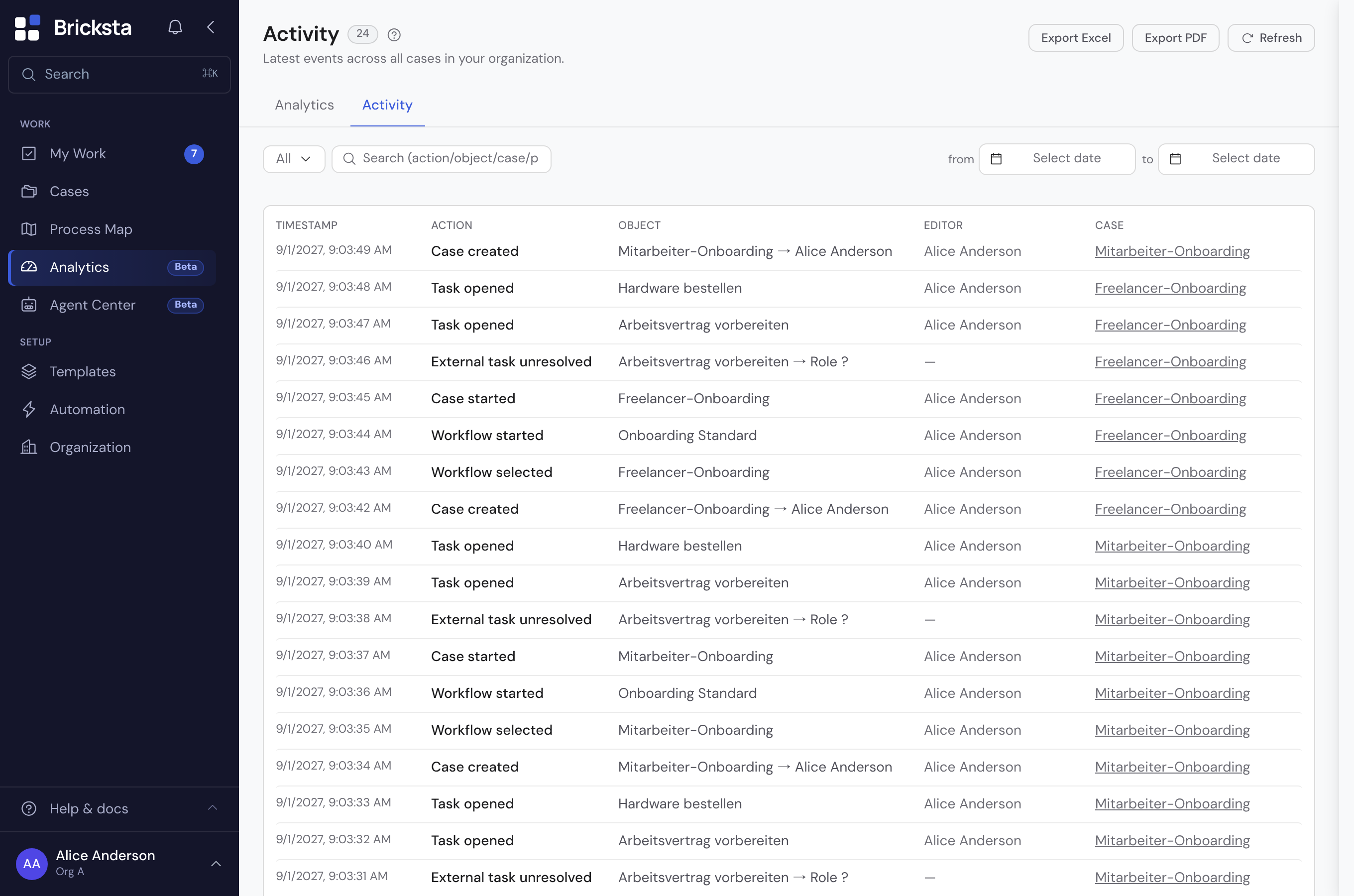
Every important event is recorded: when a case is created or started, a task is opened, taken on, completed or blocked, or a comment is written. Each row names the time, the action, the affected object, the editor and the related case. Entries appear chronologically, the most recent first.
Filtering and searching
- Narrow down by event type — for example only assignments or only completions.
- Restrict to a period (from / to).
- Narrow to ONE case: the link “Open in activity feed” in a case’s activity panel brings you here with the case already selected. The “Case” selector then shows what is narrowed; “All cases” releases it. The filter never reveals anything you could not see without it.
- Full-text search across action, object, case and person.
- Use “Load more” to page further into the past.
- The number next to the heading is the hit count for your current filters — how many events match in total, not how many are currently loaded. It therefore does not change as you page through, only when you change the filters. Only what you are allowed to see is counted.
- Your narrowing lives in the page address: it survives a reload and the back button, and you can pass the address on as a link — the recipient then sees the same excerpt (“take a look at what happened to this object on Sep 3”). They still only see what they are allowed to see anyway; the link shares the filter, not access.
Exporting
You can export the filtered history as Excel or PDF — for evidence, audits or sharing outside Bricksta. A single case can additionally be pulled as a protocol PDF (header data + history) straight from the case.
An export covers at most 20,000 events. When that limit is reached, the document says so itself: the header line then reads “at least 20000 events (export limit reached)” instead of an exact number, the CSV carries the same note as its last line, and a hint appears in the view. Narrow the period or the filter in that case — otherwise the record is incomplete without the recipient being able to tell.
Because every step is logged without gaps, it is always traceable afterwards who did what and when.