On this page
What focus view is for
The sheet lowers the barrier to entry — especially for occasional or less tech-savvy users who prefer to fill in a form field by field rather than navigate a task list. One task equals one sheet: a large form, one work step, one primary action.
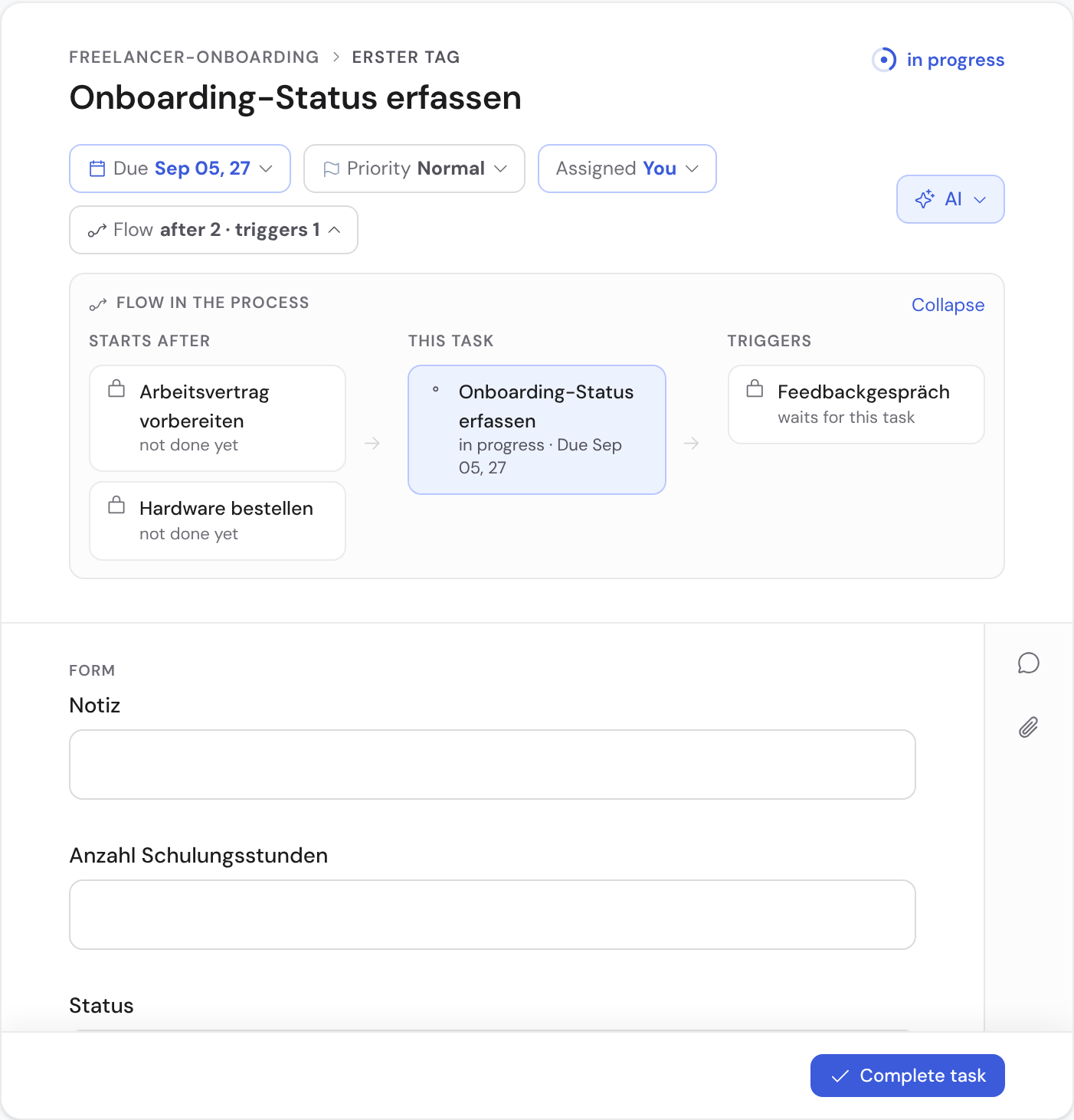
Opening the sheet
Under “My Work”, clicking a task takes you to its own page — an address you can share, with a working back button. Inside a case you expand the task in its row instead: the same sheet appears right there, without leaving the page.
The sheet is the same in both places — not a separate mode with its own rules. What you enter here is the same task.
The flow in the process
Above the form sits the “Flow” chip with two numbers. Clicking it expands “Flow in the process”: on the left, under “Starts after”, the tasks this one was waiting for; on the right, under “Triggers”, the ones waiting for it. Every neighbour card says where it stands — “done” with time and person, “not done yet”, “waits for this task”, or the condition in plain words. A click jumps to the neighbouring task.
The flow does not stop at the phase boundary. Predecessors also include the last tasks of the immediately preceding phase, and successors the first tasks of the following phase. So even a task sitting at the very start or the very end of its phase shows you where it comes from and where it leads.
An empty column does not mean the same thing on both sides. On the left, “Starts the process” is a statement — this task genuinely has no predecessor; “Loading …” only means the neighbours across the phase boundary are still being fetched, so wait a moment and the answer appears. If the lookup did not answer at all, the column reads “Predecessors could not be loaded” with “Try again” next to it: the list is then unresolved, not empty — the chain deliberately claims nothing in that case. On the right, the column says “No successor”.
Filling in and completing
- Fill in the fields — required fields, format checks, AI suggestions, attachments and comments apply as usual.
- If required fields are missing, “Complete task” stays in the form, marks the open fields and jumps to the first one — you are not sent on first.
- Once all required fields are filled, “Complete task” completes the task — directly, with no interim page; for five seconds afterwards an undo message lets you take the step back. If an approval is configured, it is submitted instead.
- Comments and files live in the column on the right. The comment button on a field opens it at the matching thread.
Because both places show the same sheet, you can work on a task inside the case or under “My Work” as you prefer — with no difference to the result or the handling.
Limits
Today you fill in exactly one task per sheet. A multi-page process document that stacks several tasks of a case into one continuous paper-style document is not yet available.